
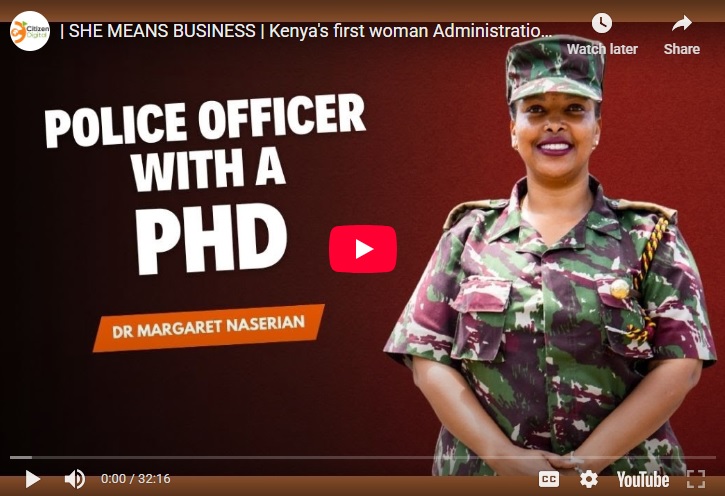
Dr. Margaret Naserian Gakami has etched her name into Kenya’s history books after becoming the first woman in the Administration Police Service to earn a Doctor of Philosophy (PhD)—a landmark achievement that resonates far beyond the uniformed services. Her journey is not only a personal triumph but a powerful statement on the role of education, leadership, and resilience in strengthening public institutions.
From Trainee Officer to Trailblazer
Dr. Gakami’s career began at the most foundational level—as a trainee officer in the Administration Police. Through discipline, consistency, and a clear sense of purpose, she steadily rose through the ranks to become an Assistant Superintendent of Police (ASP). Each promotion reflected years of frontline service, operational responsibility, and leadership under pressure.
Today, she has served as the Sub-County Commander for Dagoretti South, one of Nairobi’s most demanding security jurisdictions. The role places her at the center of:
-
Security coordination
-
Community policing initiatives
-
Crime prevention and response
-
Multi-agency operational leadership
Dagoretti South is a high-density, high-pressure environment—making her leadership experience both intense and impactful.
Pursuing a PhD While Serving on the Frontline
What makes Dr. Gakami’s story exceptional is that her academic journey ran parallel to an active law enforcement career. Policing is defined by long hours, unpredictable deployments, transfers, and constant operational readiness. Against this backdrop, pursuing a PhD is an extraordinary undertaking.
Dr. Gakami made a deliberate and strategic decision to invest in advanced education—not as a departure from service, but as a way to deepen it.
Her doctoral studies were driven by:
-
A desire to understand leadership and institutional systems
-
The need to influence policy and organizational reform
-
A commitment to improving public service delivery from an informed, evidence-based perspective
Her achievement challenges the notion that academic excellence and disciplined service are incompatible.
“She Means Business”: Speaking Truth to Power
In an interview on She Means Business, hosted by journalist Claire Munde, Dr. Gakami offered a rare and honest reflection on her journey.
She spoke candidly about:
-
The discipline and sacrifice required to balance doctoral studies with policing
-
The emotional and physical toll of juggling family, work, and academia
-
The unspoken barriers women face in uniformed services
These barriers include entrenched cultural expectations, limited mentorship, and a scarcity of women role models at senior command and academic levels.
Her story sheds light on challenges many women experience but few get to articulate publicly.
Redefining Leadership in Uniform
Dr. Gakami’s success directly confronts long-held perceptions about career ceilings within disciplined forces. For decades, senior leadership and academic authority in security institutions have been viewed as mutually exclusive—or inaccessible to women.
Her achievement demonstrates that:
-
Education strengthens operational leadership
-
Academic insight improves institutional decision-making
-
Professional growth does not end at command roles
She represents a new model of leadership—one that blends intellectual rigor with operational credibility.
Impact Beyond the Individual
While the PhD is a personal milestone, its implications are collective. Dr. Gakami’s journey:
-
Opens doors for women officers aspiring to higher education
-
Encourages male and female officers alike to pursue academic growth
-
Reinforces the importance of professional development in police reform
As Kenya continues national conversations around policing reforms, leadership accountability, and institutional capacity-building, her story stands as proof that reform is not only structural—it is also human.
A Symbol of What Is Possible
Dr. Margaret Naserian Gakami’s journey sends a clear message:
Frontline service and intellectual growth are not opposing paths—they are mutually reinforcing.
Her life’s work affirms that disciplined forces can—and should—be spaces where knowledge, leadership, and service coexist. For young women in uniform, her story is not just inspirational; it is permission to dream bigger.